brand divider brand divider brand divider brand divider brand divider brand divider brand divider brand divider brand divider brand divider brand divider brand divider brand divider brand divider brand divider brand divider brand divider brand divider brand divider brand divider brand divider brand divider brand divider brand divider brand divider brand divider brand divider brand divider brand divider


We aim to support sustainable food systems, working towards net zero across our value chain by 2050 through climate and nature actions, providing long-term value for customers.


brand divider brand divider brand divider brand divider brand divider brand divider brand divider brand divider brand divider brand divider brand divider brand divider brand divider brand divider brand divider brand divider brand divider brand divider brand divider brand divider brand divider brand divider brand divider brand divider brand divider brand divider brand divider brand divider brand divider

Our approach


Importance to Woolworths Group


Our business and our suppliers rely on a healthy planet to meet customer needs. Climate change and nature loss are increasingly impacting food production, including product availability and affordability. Extreme weather events already impact our operations, highlighting a potential risk to business continuity. Reducing supply chain impacts on nature, and investing in business resilience and adaptation is critical in protecting and growing value for the long term. 

Impact of prioritising this area 


Our extensive supply chain provides a significant opportunity to support sustainable food systems, including through climate and nature-based actions, and animal welfare programs. By partnering with suppliers, industry, and government to reduce our collective climate and nature footprint, we can enable sustainable food production, build resilience against disruptions, and support the continued availability and affordability of food for our customers. We will report on our priorities, progress, impact, and challenges through our annual disclosures.

brand divider brand divider brand divider brand divider brand divider brand divider brand divider brand divider brand divider brand divider brand divider brand divider brand divider brand divider brand divider brand divider brand divider brand divider brand divider brand divider brand divider brand divider brand divider brand divider brand divider brand divider brand divider brand divider brand divider

Our goals

Towards net zero by 2025, we aim to:


Reduce absolute scope 1 and 2 GHG emissions by 80% by F30, from a F23 base year
Reduce absolute scope 3 GHG energy and industrial emissions by 55% by F33, from a F23 base year
Reduce absolute scope 3 FLAG GHG emissions by 40% by F33, from a F23 base year

Towards positive action on nature by 2050, we aim to:


Continuously improve our sustainable sourcing through commodity-specific plans
Drive positive animal welfare outcomes through continuous improvement of our standards
Transition to deforestation-free sourcing across primary deforestation-linked commodities
brand divider brand divider brand divider brand divider brand divider brand divider brand divider brand divider brand divider brand divider brand divider brand divider brand divider brand divider brand divider brand divider brand divider brand divider brand divider brand divider brand divider brand divider brand divider brand divider brand divider brand divider brand divider brand divider brand divider

Our journey to date

With the completion of our five year Woolworths Group Sustainability Plan 2025 we reflect on the meaningful progress we’ve delivered including:

100%

renewable electricity

22.9%

reduction in Scope 1 & 2 operations emissions relative to our F23 base year

~ 100%

net-zero deforestation single product sugar, coffee and tea in our own brand products

brand divider brand divider brand divider brand divider brand divider brand divider brand divider brand divider brand divider brand divider brand divider brand divider brand divider brand divider brand divider brand divider brand divider brand divider brand divider brand divider brand divider brand divider brand divider brand divider brand divider brand divider brand divider brand divider brand divider

Our initiatives

100% renewable electricity

100% renewable electricity

100% renewable electricity

100% renewable electricity

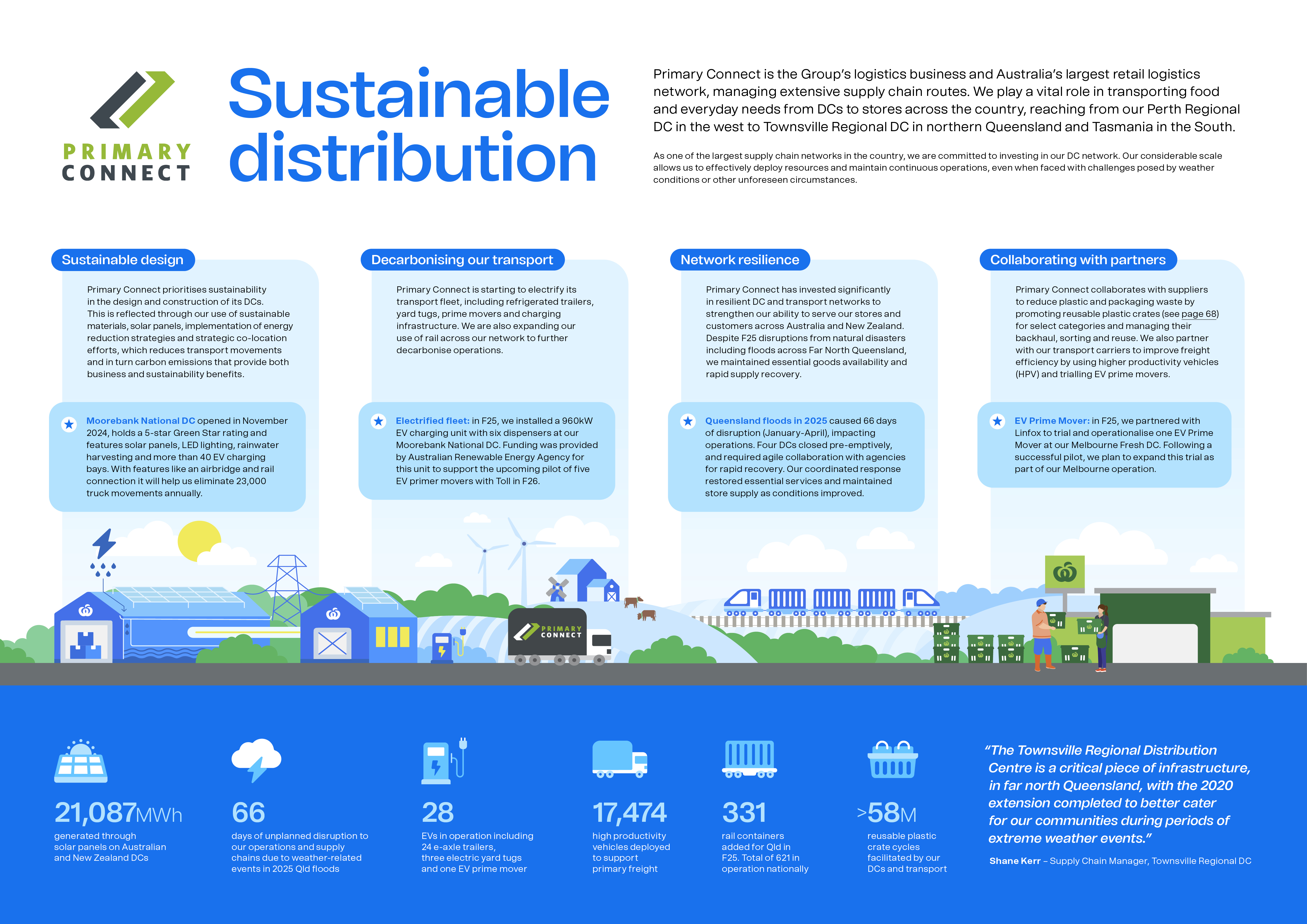
Sustainable distribution

Sustainable distribution

Sustainable distribution

Sustainable distribution

innovation in pork production

Innovation in pork production

innovation in pork production

Innovation in pork production

sustainable seafood

Sustainable seafood

sustainable seafood

Sustainable seafood

deforestation

Delivering no deforestation products

deforestation

Delivering no deforestation products

brand divider brand divider brand divider brand divider brand divider brand divider brand divider brand divider brand divider brand divider brand divider brand divider brand divider brand divider brand divider brand divider brand divider brand divider brand divider brand divider brand divider brand divider brand divider brand divider brand divider brand divider brand divider brand divider brand divider

Our partnerships


We're driving real change through active partnerships across our value chain. By working directly with suppliers, communities and industry, we're implementing solutions that deliver measurable impact on climate and nature.

We listen to what matters most to our stakeholders. This understanding shapes our priorities and shows us where we can make the greatest difference.

Our partnerships across Woolworths Group vary in scope but share one goal: tangible progress.


Certifications

certified sustainable seafood
ozharvest
rainforest alliance certified
fairtrade
certified sustainable sugarcane


Benchmarking

cdp logo
RE100 logo


Partners

climate leaders coalition logo
SAI Platform
the sustainability consortium logo

brand divider brand divider brand divider brand divider brand divider brand divider brand divider brand divider brand divider brand divider brand divider brand divider brand divider brand divider brand divider brand divider brand divider brand divider brand divider brand divider brand divider brand divider brand divider brand divider brand divider brand divider brand divider brand divider brand divider

Find out more


Climate: towards net zero

We achieved our goal to achieve 100% renewable electricity across our operations in Australia and New Zealand by the end of 2025. As one of the largest users of electricity in the region, this transition will have a significant impact on our carbon footprint, as electricity use accounts for the majority of our scope 1 and 2 emissions footprint.

Our strategy combines:

  • On-site solar generation: We’re expanding our on-site solar generation, with a network of over 320 systems that makes us one of the largest commercial solar operators in Australian retail. 

  • Strategic partnerships: We have secured contracts across all Australian states and New Zealand, which includes strategic partnerships with Bango Wind Farm, Smartest Energy, Iberdrola and CleanCo to leverage a mix of wind and solar. 

  • Renewable energy certificates: We acquire additional large-scale generation certificates (LGCs) to match remaining electricity consumption and benefit from the increasing default renewable electricity delivered through the grid .(1)

  • Energy efficiency: We continue to focus on energy efficiency initiatives across our stores. These initiatives include refrigeration upgrades, more efficient equipment, LED lighting, and store retrofits such as fridge doors.

We also welcome the continued efforts and investment from the federal government in the transition of the national grid.

(1) Woolworths remains connected to the electricity grid, with onsite solar reducing electricity consumption where installed. In line with RE100 guidance on credible renewable claims, we acquire and surrender large-scale generation certificates (LGCs) to match remaining electricity consumption. This ensures no other entity can claim the same renewable electricity and prevents double-counting

Emissions from our operations

Scope 1 and 2 emissions are those directly within our operational control. Our material scope 1 emissions sources include fugitive synthetic refrigerants, transport fuel for our fleet cars and home delivery trucks, and natural gas. Our scope 2 emissions form the largest part of our operational emissions, and are primarily from the electricity use across our store network, distribution centres and offices. 

We aim to reduce absolute scope 1 and 2 GHG emissions 80% by F30. In F25, our scope 1 and 2 emissions reduced by 22.9% compared to our F23 baseline.

Emissions from our value chain  

Scope 3 emissions are indirect emissions from Woolworths Group’s upstream and downstream value chain. In F25, our scope 3 emissions are approximately 23 times greater than scope 1 and 2, making up 96% of the emissions in the end-to-end value chain.(1) Managing scope 3 emissions is complex, representing emissions from a variety of sources – the largest being agriculture, energy and transport.

In our F23 base year, approximately 50% of these emissions were from forest, land and agriculture (FLAG) sources generated pre‑farmgate. The remaining 50% were from energy and industrial sources such as post‑farmgate electricity and gas, services, packaging, transport, and downstream waste.

We aim to reduce absolute scope 3 GHG energy and industrial emissions 55% by F33 from a F23 base year. We also aim to reduce absolute scope 3 FLAG emissions 40% by F33 from a F23 base year.

Scope 3 emissions are challenging to address because they’re outside of Woolworths Group’s direct control. We rely on value chain partners, industry, and government to make progress. A net-zero economy cannot be achieved alone and collective action is truly needed. The Group is committed to working hand-in-hand with farmers, suppliers, industry, government, and customers to drive meaningful change towards shared sustainability objectives.


(1) In measuring scope 3 emissions the Group relies primarily on sector-based average emission factors, in the absence of reliable direct emissions data from the supply chain. Where available, the Group draws on country and sector-specific emission factors. As a result, reported scope 3 emissions incorporate an inherent level of uncertainty, and do not yet appropriately isolate restatements (associated with maturing data sources) from true emission reductions.

For more information see our Annual Disclosures.


Towards positive action on nature

No deforestation goal

By sustainably sourcing our products and ingredients, we aim to make it easier for customers to make  sustainable choices. We’re committed to working collaboratively with our suppliers and other supply chain partners to minimise negative environmental and social impacts. Additionally, we consider other high-risk commodities such as tea and coffee.

Woolworths Group aims to achieve no-deforestation across our primary deforestation-linked commodities.

Our Primary Deforestation-Linked Commodities are:

  • Paper, pulp & timber (packaging and products)

  • Palm oil (food and non-food) 

  • Cocoa

  • Soy (in Stockfeed)

  • Fresh beef

Our No-Deforestation target applies to both own brand and vendor brand products.

Our Group No-Deforestation Policy, details our approach to our No-Deforestation target focused on commodities presenting the most material risk of deforestation within our supply chain. 

Paper, pulp and timber

In addition to supporting our No-Deforestation target, our Paper, Pulp and Timber Policy has been updated to support our compliance with illegal logging legislation. The policy applies to all Paper Pulp and Timber used in products, primary packaging or secondary packaging for Woolworths own brand products, or vendor branded products where Woolworths is the importer into Australia

Net-zero Deforestation

Some additional commodities are not part of our updated No-Deforestation target, but remain within scope of our existing Net-zero Deforestation target. We will continue to source products containing the following commodities to a Net-zero Deforestation standard in our own brand products:

  • Soy (food)

  • Tea (product and ingredient)

  • Coffee (product and ingredient)

  • Sugar

Policy - Net-Zero Deforestation

We have met our 2020 Sustainability Commitment to have all Woolworths own brand coffee, tea, cocoa and sugar single ingredient products sourced sustainably and certified through Rainforest Alliance, Fairtrade or Bonsucro Certification.

Our understanding of climate change, nature loss, and their impact on business resilience,will continue to evolve. In F24, we adopted SBTi guidance for FLAG which has connected our no-deforestation and emissions reduction goals, highlighting the importance of nature-based solutions in our decarbonisation strategy

Taskforce on Nature-related Financial Disclosures risk assessment 

As we look towards our future strategic direction, we conducted a nature risk assessment this year aligned to the Taskforce on Nature-related Financial Disclosures (TNFD) LEAP1 framework. This allowed us to identify and prioritise key nature-related impacts, dependencies, risks and opportunities across our operations and key supply chain commodities. The insights from this assessment will inform our ongoing approach to nature.

Improving the responsible stewardship of natural resources We actively engage with suppliers and industry to increase adoption of sustainable and regenerative agriculture practices across our supply chains, focusing on holistic benefits for climate, nature, animal welfare and productivity gains across the entire farming system.

Assessing regenerative practices

In F25, we completed a project with LeaderBrand Produce and Plant and Food Research, co-funded and supported by New Zealand’s Ministry for Primary Industries (MPI), to assess regenerative practices in intensive vegetable production. The three-year project analysed the impact of compost and cover crops on soil health and productivity. Field trials showed varied benefits depending on soil type and crop rotation, with one site seeing significant yield increases and reduced input costs. The project also highlighted the importance of compost quality for weed control. The project team is leveraging findings from the trials to enhance agricultural practices across NZ.


For more information see our Annual Disclosures.

brand divider brand divider brand divider brand divider brand divider brand divider brand divider brand divider brand divider brand divider brand divider brand divider brand divider brand divider brand divider brand divider brand divider brand divider brand divider brand divider brand divider brand divider brand divider brand divider brand divider brand divider brand divider brand divider brand divider
Our commitment 

Woolworths Group is committed to responsible sourcing of seafood. Ecologically responsible fisheries and aquaculture are critical to reduce the environmental impacts of seafood production, while safeguarding people and animal welfare. Priority must be placed on fishing and farming more responsibly to support fish stocks and marine ecosystems regeneration, to continue to provide for future generations. 

Woolworths Group is also committed to respecting the human rights of workers in its supply chain and notes the detrimental impact that unsustainable seafood sourcing can have on vulnerable communities, including Indigenous peoples and migrant workers, as well as access to safe water and sanitation. Our approach to responsible sourcing is available here.

Own brand sourcing 

All Woolworths own brand behind-the-counter, fresh packaged, frozen, canned and ingredient seafood sold within our Australian Supermarkets and Metro Stores is responsibly sourced, as defined in our Woolworths Group Seafood Sourcing Policy

We completed our transition to ecologically responsible sourcing for all our own brand seafood in 2022, and for seafood ingredients in 2025.

Whenever you see our Woolworths Responsibly Sourced symbol, this means that the seafood you are buying meets the requirements laid out in our Woolworths Group Seafood Sourcing Policy.

responsibly sourced logo
Farmed seafood

We source from aquaculture operations that are third-party certified or independently verified. Accepted certifications are: 

Where farmed seafood products carry the ASC logo these products are additionally assessed against the ASC Chain of Custody Standard.

The ecological responsibility of mussels and oysters farmed in Australia have undergone an extensive risk assessment by an expert third party and are approved for sourcing as independently verified.

Wild-caught seafood

We source from fishery operations that are third-party certified or independently verified.

Where wild caught seafood products carry the MSC logo these products are additionally assessed against the MSC Chain of Custody Standard.

Awards and recognition 

Woolworths Group was recognised by the Marine Stewardship Council as the National Community Champion for 2025 at the Sustainable Seafood Awards Australia. The third time we've received this award.

This recognises our support for our suppliers and communities to produce ecologically responsible seafood.


sustainable seafood awards
sustainable seafood community champion
winner sustainable seafood champion

The Marine Stewardship Council (MSC) is an international non-profit on a mission to end overfishing that set standards for sustainable fishing and traceability within the seafood supply chain.

When you see the MSC blue fish tick on a wild-caught seafood product or menu, it can be traced back to an MSC certified sustainable fishery. By looking at each fishery individually using science, fisheries prove and improve their sustainability performance.

There's a wide variety of wild-caught sustainable seafood with the MSC blue fish tick label available at Woolworths. This includes family favourites such as tuna, salmon and prawns.


certified sustainable seafood

Animal Welfare

Our commitment 

Woolworths Group is committed to protecting the welfare of animals in our supply chain. We recognise that animal welfare is fundamental to our business because good animal welfare results in quality products and our customers trust us to do the right thing. The Woolworths Group Animal Welfare Policy is based on the ‘Five Freedoms of Animal Welfare’ framework. (1, 2)

Our approach 

We recognise that animals are sentient beings and should experience positive health and wellbeing. We are committed to continually improving our animal welfare policies and procedures. We acknowledge the ‘Five Domains model’ (3), which reflects the evolution of animal welfare from merely avoiding negative experiences, as outlined in the Five Freedoms, to recognising animals’ emotional capabilities and the need for positive experiences (4). In collaboration with our suppliers, we aim to go beyond the Five Freedoms and provide animals with a ‘life worth living’. 

The 'Five Freedoms' and 'Five Domains' are:

The Five FreedomsThe Five Domains
  1. Freedom from hunger and thirst by providing ready access to fresh water and a diet to maintain health and vigour.

  2. Freedom from discomfort by providing an appropriate environment including shelter and a comfortable resting area.

  3. Freedom from pain, injury or disease through prevention, rapid diagnosis, and treatment. 

  4. Freedom to express normal behaviour by providing sufficient space, proper facilities, and the company of the animals' own kind.

  5. Freedom from fear and distress by ensuring conditions and treatment which avoid mental suffering.

  1. Nutrition - providing sufficient, balanced, varied and clean food and water. 

  2. Environment - providing comfort through temperature, substrate, space, air, odour, light, noise, environmental variability and predictability

  3. Health - enabling good health through the absence of disease, injury, impairment, poisoning, appropriate body condition and with a good fitness level

  4. Behaviour - provision of varied, novel and engaging environmental enrichment through sensory inputs, exploration, foraging, bonding, playing, retreating, sleep and others. 

  5. Mental State - the animal should benefit from predominantly positive states, while reducing negative states


We work in collaboration with the agricultural industry across the different protein areas we source from and align where possible. In addition to this, we consult with veterinarians, academics, government representatives, training providers, The RSPCA, World Animal Protection, and Compassion in World Farming.  We are working with FAI Farms Limited, global independent animal welfare and sustainability consultants to help us on the journey of improving our animal welfare metrics.

1. Brambell FWR, (1965), Report of the Technical Committee of Enquiry into the Welfare of Livestock kept under intensive livestock husbandry systems; HMSO: London, UK.

2. Farm Animal Welfare Council, (2009), Farm Animal Welfare in Great Britain: Past, Present and Future; FAWC: London, UK.

3. Mellor, D.J., (2016), Updating Animal Welfare Thinking: Moving beyond the 'Five Freedons' towards a 'Life Worth Living'; Animals, (Basel).

4. Mellor, D.J., (2017), Operational Details of the Five Domains Model and Its Key Applications to the Assessment and Management of Animal Welfare; Animals, (Basel).

brand divider brand divider brand divider brand divider brand divider brand divider brand divider brand divider brand divider brand divider brand divider brand divider brand divider brand divider brand divider brand divider brand divider brand divider brand divider brand divider brand divider brand divider brand divider brand divider brand divider brand divider brand divider brand divider brand divider

Governance

Our animal welfare commitments are underpinned by our animal welfare policy and strategy. The Sustainability Committee of the Board of Woolworths Group Limited has a Charter which details the committee’s duties. Animal welfare is included under the Environment section.

The Sustainability Committee is responsible for reviewing the effectiveness of Woolworths Group’s Sustainability policies and initiatives, including animal welfare. Woolworths’ senior management has accountability for managing farm animal welfare as part of the governance of our sustainability program, through regular Sustainability Steering Committee meetings. We publicly report our progress on animal welfare in our annual disclosures. We hold regular meetings with our senior team to review our progress across animal welfare in the protein space. 

Policies

We are committed to the health and welfare of the animals within our supply chain. We are working with our suppliers and farmers to drive improvement and influence best practice. Woolworths' animal welfare standards cover all practices from animal rearing, health, welfare, feed, production systems, environment, stocking density, through to transport and slaughter. Our policies apply to all species used in our own brand products and are implemented through our Woolworths Supplier Excellence Audit program which covers all business units. The Supplier Excellence Audit program is a series of audits suppliers need to successfully complete based on a variety of Codes of Practice developed by Woolworths. This ensures the consistent supply of safe, ethical, quality and legally compliant products. All our own brand suppliers receive regular training around our standards. In addition, all abattoirs are independently audited by a third party to the relevant sector requirements detailed in our animal welfare policy. 

Implementation

Woolworths’ own brand suppliers must adhere to our policies and procedures. Our Animal Welfare requirements are included in our product briefs and brand guidelines and form part of our contractual obligations with suppliers. In addition to this, all suppliers must be part of a third-party assurance scheme as well as being audited against Woolworths Codes of Practice within the Supplier Excellence Program.  These measures are reported through our internal audit programs to the Sustainability Team and the relevant commercial and technical teams. More details can be found below about the sector-specific requirements.

Management

Day to day, animal welfare is managed by our Planet Team within Group Sustainability. Woolworths teams regularly assess and analyse to ensure compliance and track progress against our commitments. It is the responsibility of the Planet Team and relevant category team members to investigate and resolve any non-compliances and ensure these are closed out correctly and promptly. Appropriate action will be taken on suppliers who are not complying to our standards and expectations.  Actions taken could include enhanced auditing for consistent poor performers, or additional technical support or training.  In serious cases suppliers will be excluded from supply.

Data Recording of Welfare Metrics

Our suppliers must record progress against Welfare Outcome Measures (WOMs) and supply data as required (the frequency of data collection has been defined for each species). These outcomes help us identify animal welfare issues concerning physical, mental and behavioural wellbeing. This data is used to allow us to quantify our performance and measure continual improvement within our supply chains. Some of the data metrics captured include injured animals, transport time, slips, trips, falls and vocalisation and dead-on arrival (DOA’s). The data metrics collected are species specific. In addition to this, we also collect data about our supply chains through supplier audits, on-site visits and regular supplier animal welfare questionnaires. 

Processing Site and Abattoirs Requirements 

All our processing plants for beef, lamb and pork must be independently certified annually by the Australian Livestock Processing Industry Animal Welfare Certification System (AAWCS) as well as meeting our own Woolworths standards for our abattoirs which covers animal welfare across transport, lairage and slaughter. Both audits are conducted by an independent 3rd party certification body, results are reported to the Woolworths team including the Planet Team and Greenstock Processing Team and any non-conformances are actioned immediately by the supplier.

The AAWCS best practice standards cover all aspects of animal welfare, from receival of livestock at the establishment to the point of processing. The standard covers planning, procedures, facilities, equipment, training and livestock handling; including minimising stress and injuries all helping to prevent or mitigate risks to animal welfare.

All our poultry sites are audited annually to the RSPCA Approved standards.

In New Zealand all abattoirs are licensed and independently audited by the Ministry for Primary Industries.  

Animal Welfare Training - Woolworths Team Members

We see training our people as a crucial part of helping deliver our animal welfare commitments and requirements.  All those involved in handling live animals must be appropriately trained, including Woolworths staff.  Our suppliers and farmers must meet the training requirements within industry standards and meet any additional requirements within any independent standards which are applicable. 

The Planet Team provides training to team members in the animal welfare space. We hold regular training sessions around animal welfare for our team members concerning the overview of policy and commitments, changes in policy, and updating of standards.  In addition to this, job changers or new starters who are going to be working in the protein area will also have training in the requirements for that area. 

We provide content for our store team members who are involved in the selling of protein products around the sourcing criteria which includes the animal welfare standards so that they can communicate our progress and ambitions in improving farm animal welfare.

Supplier Support

We believe collaboration with our suppliers will help achieve the best outcomes. We actively engage with our supply base through on-site visits, training on our standards and training through our supplier platforms. Our Planet and sourcing teams, including the Greenstock Livestock Sourcing Team, make regular visits to our farmers and suppliers. These visits support them on the implementation of our sourcing requirements including our animal welfare policy and procedures. Any issues on these visits regarding animal welfare will be raised to the Woolworths Planet Team as well as the senior team at the supplier. We regularly meet with suppliers to discuss and ensure they are either maintaining or working towards our prescribed standards and identifying opportunities where further support from Woolworths or its partners may be required. Woolworths also hosts a variety of supplier updates across the year where Quality, Commercial, and Sustainability teams update on progress and any new requirements. 


Woolworths Australia

brand divider brand divider brand divider brand divider brand divider brand divider brand divider brand divider brand divider brand divider brand divider brand divider brand divider brand divider brand divider brand divider brand divider brand divider brand divider brand divider brand divider brand divider brand divider brand divider brand divider brand divider brand divider brand divider brand divider

The RSPCA Approved Farming Scheme is a leading Australian independent animal welfare certification that has been improving the lives of Australia’s farmed animals for over 25 years. Certified farms undergo independent assessments by RSPCA Assessors and adhere to rigorous animal welfare standards. Since 2014, Australian Supermarkets has been collaborating with suppliers to source RSPCA Approved products, providing customers with higher welfare food options and supporting farmers who adopt these standards. 

“Woolworths' participation in the RSPCA Approved Farming Scheme means farms supplying the supermarket undergo a robust certification process and millions of birds are reared with a focus on animal welfare every year. Because of this commitment by Woolworths and their suppliers, it's easier than ever for customers to support better farming by choosing certified higher welfare RSPCA Approved chicken and turkey when they shop.” Richard Mussell, RSPCA Australia CEO.

We continue to work closely with the RSPCA and have generated a series of educational videos which are used as part of our Animal Welfare training but also used as part of our marketing of the RSPCA Approved products. Read the RSPCA’s blog RSPCA Approved chicken in Woolworths – and what’s it all about?

RSPCA Approved Good Food Series - Setting the standards

RSPCA Approved Good Food Series - Raising the standards

RSPCA Approved Good Food Series - Embracing the standards

RSPCA Standards are publicly available to download here.

brand divider brand divider brand divider brand divider brand divider brand divider brand divider brand divider brand divider brand divider brand divider brand divider brand divider brand divider brand divider brand divider brand divider brand divider brand divider brand divider brand divider brand divider brand divider brand divider brand divider brand divider brand divider brand divider brand divider

Poultry and eggs are an important component of many of our customers' daily diets and the welfare of these birds need to be met at all times. 100% of the fresh poultry and eggs used in our Australian products are produced from farms regionally across Australia.  

Our suppliers are all trained in relevant sector-specific requirements e.g., RSPCA Approved or FREPA as well as meeting Woolworths’ Supplier Excellence Programme standards.

Chicken

100% of Woolworths own brand fresh chicken and ingredient chicken (where chicken is a defined ingredient) in Woolworths own brand products comes from higher welfare RSPCA Approved farms (1). The RSPCA Approved Farming Scheme focuses on improving farm animal welfare. Farms that participate in the scheme are regularly assessed independently by the RSPCA and raise their animals to detailed animal welfare standards. These assessments ensure that Woolworths Chickens are farmed according to the RSPCA Approved Farming Scheme Standard.  Birds are provided with environmental enrichment, such as perches and pecking objects, good quality litter for dustbathing and are given more space to encourage them to be active and exhibit natural behaviours.  Any non-conformances with the Standard raised at an assessment will be closed out as soon as possible. Audit performance is discussed at regular meetings between RSPCA Australia, Woolworths and the supplier. This helps to identify any areas that require improvements in the next year.

RSPCA Approved chicken farms focus on providing for the bird’s behavioural and physical needs. Meat chickens have good lighting which encourages them to be active during the day, whilst also having sufficient dark periods for rest. They have more space to move about, flap their wings, forage, and scratch. Perches are given so birds can perch to rest and keep their bones and muscles strong. Good quality litter is provided and managed so that birds can dustbathe and keep their feathers clean. These provisions, along with a combination of factors, provide meat chickens with a better quality of life.

Logo

Our Woolworths own brand RSPCA Approved chicken is grown to:

  • 28kg per m2 stocking density for non-mechanically ventilated systems. 

  • 34kg per m2 stocking density for tunnel, extractive or other mechanically ventilated systems.

All our products that contain RSPCA Approved chicken carry the RSPCA Approved certification.

“The RSPCA has been proud to work with Woolworths and their suppliers to ensure all their own brand fresh chicken is sourced from RSPCA Approved farms since 2014. Now all of Woolworths branded fresh chicken and the Australian chicken used as an ingredient in Woolworths branded products is 100% RSPCA Approved. A significant achievement that demonstrates the company’s recognition that improving animal welfare applies to products across their ranges, and not just the fresh produce category. RSPCA Australia looks forward to continuing our work with Woolworths, to improve the welfare of farm animals across their supply chains.” RSPCA Australia

Turkey

All Woolworths own brand fresh whole turkey comes from higher welfare RSPCA Approved farms.

In 2020, we transitioned to source all our Woolworths brand fresh whole turkeys to RSPCA Approved farms in time for Christmas.

Turkeys on RSPCA Approved farms are encouraged to be active. They have good lighting, perches, dry litter floor covering to scratch and dust bathe, interesting objects to peck and space to move.  These provisions, along with a combination of factors, provide turkeys with a better quality of life.

Eggs

At Woolworths, eggs are an important component of many of our customers’ shopping baskets. To ensure quality and food safety, all Woolworths own brand eggs must be produced to the Woolworths Supplier Excellence Audit program, which includes complying with the egg industry’s own Quality Assurance program, Egg Standards of Australia (ESA). All Woolworths brand eggs must meet ESA Level 3 for Rearing and Layer Farms or equivalent, or higher. 

ESA for Rearing and Layer Farms covers all aspects of production including hen welfare, egg quality, biosecurity, worker health and safety, and environmental management. The aspects of animal welfare which must be complied with are:

  • ensuring employees handling the hens receive adequate training to do so

  • provision of ideal lighting and air quality

  • provision of adequate food and water to the hens in a safe environment

  • provision of environmental enrichments such as perches and nesting boxes

  • maintenance of a healthy stocking density

  • daily monitoring of hen health and production. 


All Woolworths own brand suppliers are assessed annually to ensure their compliance with ESA Level 3 for Rearing and Layer Farms.


We are also committed to offering customers a range of eggs that support animal welfare outcomes. Selected stores in South Australia offer Rohde's Free Range Eggs, which have been a part of the RSPCA Approved Farming Scheme for well over a decade. 


At Woolworths, the own brand products we sell, which are 100% cage free, are split between:

  • barn raised (maximum 30kg hens/ m2 stocking density)

  • free range (maximum 10,000 birds per hectare stocking density)

  • organic (maximum 1,500 birds per hectare stocking density)


In addition to ESA Level 3, our organic eggs are also produced to the Australian Certified Organic standard.


It is important to ensure that egg laying hens have access to environmental enrichment so that they can express their natural behaviours. 100% of our egg layer hens for Woolworths own brand have access to enrichment, including a range of perches, pecking projects, hay/straw bales, trees and dust bathing boxes.


For more information see our Annual Disclosures


(1) Excludes chicken in pet food, derivatives in cooking products as ingredients or products (e.g. gravy, stock, fat, gelatine and extracts). Our small number of imported canned and boxed chicken products are certified by independent foreign accreditation

It is important to us that cattle in our supply chains are raised in a way that promotes responsible production to benefit people, communities, and the planet.

All our Woolworths cattle are sourced directly from Australian farms by one of our experienced livestock team. Our Woolworths cattle spend the beginning of their lives on farms out at grass, ensuring that all of our Woolworths cattle have access to pasture-based enrichment during their lives. Any cattle destined for grain-fed systems will be on grass until the last couple of months.  All the beef we source needs to meet the requirements of our animal welfare policy as well as meeting all national regulations, legislation and the Livestock Production Assurance (LPA) farm requirements.  Our feedlot beef is accredited by the National Feedlot Accreditation Scheme (NFAS). The NFAS incorporates a strict animal welfare component, which ensures the cattle in an accredited feedlot are well cared for and monitored daily. Feed, water and air quality, temperature and heat levels are constantly checked. If an animal displays any signs of illness, it is treated by livestock team members trained by a veterinarian.

Our Woolworths Grass fed beef range is free from artificially added growth promotants or enhancers.  Our organic beef range is free from artificially added growth promotants and free from antibiotics, the cattle are all organically fed.

Lamb

Woolworths fresh lamb is 100% Australian. All Woolworths lamb abattoirs are certified by the Australian Livestock Processing Industry Animal Welfare Certification System (AAWCS) administered by the Australian Meat Industry Council.

Pork

All our Woolworths fresh pork is Australian and independently audited to the Australian Pork Industry Quality (APIQ) standard, which means that our Woolworths fresh pork comes from systems that meet the APIQ Gestation Stall Free standards.

We have worked with our suppliers to ensure all our fresh pork is free from any artificially added hormones, growth enhancers or promotants.  Surgical castration is prohibited within our Woolworths pigs. 100% of pigs requiring castration have been immuno-castrated in line with veterinarian approval. 

Free Range Pork

Our free range pork is certified to the APIQ Free Range standard. The pigs have access to the outdoors year-round where they are free to forage, are provided with access to soil, pasture, bedding, and shelter from the elements. This enables them to exhibit natural social and physical behaviour.

For more information on our Woolworths Seafood and our seafood sourcing policy please visit Woolworths Ecologically Responsible Seafood.

At Woolworths, we support and encourage industry best practice, guidelines and initiatives around antimicrobial stewardship within our supply chains. Responsible antimicrobial usage plays a vital role in maintaining good animal health and welfare when required, in conjunction with a clearly defined and informed veterinary health strategy. 
For more information please see our Woolworths Australia Antimicrobial Stewardship policy.

brand divider brand divider brand divider brand divider brand divider brand divider brand divider brand divider brand divider brand divider brand divider brand divider brand divider brand divider brand divider brand divider brand divider brand divider brand divider brand divider brand divider brand divider brand divider brand divider brand divider brand divider brand divider brand divider brand divider

For progress against our goals, see our annual Reporting Suite.